

Buying Real Estate as a Couple in Geneva
What You Need to Know
It is a wonderful milestone: you have decided to buy your house or apartment with your spouse or partner. It is a further step in a lifelong project together, laying solid foundations for your relationship, and perhaps starting a family… It is all very positive!
And even though we all hope that “love” lasts “forever,” a wise couple is right to anticipate any potential accidents that may occur in order to limit their negative and costly effects.
This is why, whether you are married or in a cohabiting relationship, several legal, tax, and financial elements must be taken into account to avoid any unpleasant surprises in the event of separation or death.
Therefore, before signing your purchase agreement with the notary and your mortgage loan, we suggest reviewing the essential points to consider, in collaboration with our experts: Mr. Kevin Rossier of Hypo Advisors SA for the financing aspect and Maître Frédéric de le Court, tax lawyer, for the tax and legal aspects.
1. Choosing the ownership structure

-
Full ownership:
- Co-ownership: The property is held by several people, each possessing a share. Each co-owner can freely dispose of their share (sale, pledging), although in practice, the partner is often the only potential buyer, as noted by the Geneva Chamber of Notaries.
- Joint ownership (via a simple partnership).
-
Via a split ownership structure:
- Usufruct and bare ownership: This solution allows one person (the usufructuary) to retain the use of the property and receive the rents, while the bare ownership is held by another person (for example, heirs). Establishing a usufruct is often used to protect the surviving spouse, allowing them to remain in their home after the death of the first spouse, or to rent out the property to finance a stay in a nursing home (EMS).
- Right of residence: This right, more restrictive than usufruct, allows a person to occupy the dwelling without the possibility of renting it out. The right of residence is often used to protect a surviving spouse and allow them to remain in their home after the death of the first spouse. However, it is limited to personal occupation and does not allow for the property to be rented out.
The chosen ownership structure must be indicated in the purchase-sale deed. It is therefore crucial to anticipate this decision based on your family and financial situation.
It should also be noted that the property can be held by only one member of the couple. In the case of a married couple, the dwelling is considered the family home, and the spouse must give their consent in the event of a sale. A cohabiting partner, however, is not protected.

Which ownership structure should you choose?
This depends on the nature of your relationship (marriage, cohabitation) and your common goals. It is essential to fully understand the consequences of each structure and, if necessary, adapt the marriage contract or enter into a specific agreement. A lawyer and a notary will provide sound advice in this regard.
2. Financing and the distribution of contributions

To finance the purchase of a primary residence, plan for a 25% down payment (20% required by the bank and approximately 5% for purchase and mortgage costs). Kevin Rossier, a financing expert, emphasizes the need to clarify each person’s contributions from the start: “Real estate purchase involves a significant financial commitment. Before signing, it is crucial to determine:
- Who is contributing which equity funds? It is important to track respective contributions, especially if one partner invests more than the other.
- How will the mortgage debt be distributed within the couple? Is the loan taken out in equal shares or according to each person’s contribution? Who will repay what?
- What happens in the event of a separation? If one partner wishes to keep the property, can they buy out the other’s share and obtain the necessary financing?”
Why is this important?
Here is an example provided by the Geneva Chamber of Notaries regarding a couple married under the regime of separation of property. “It should be known that the law does not organize the separation of property: in the event of divorce, there is no division of assets, since these have always been separate. A spouse who contributed 70% to the purchase of the home in equal co-ownership would not benefit from any capital gain potentially linked to the amount they advanced for their spouse. They would only recover the nominal amount of their advance, or—at worst!—be faced with the argument that the advance was actually a gift, and therefore non-recoverable…”
Various solutions exist to avoid future disputes:
- Recording a different share in the purchase deed: each person holds a share corresponding to their investment.
- Establishing an acknowledgment of debt: each person holds an equal share, but the difference in financing is formalized by an internal loan.
- Repayment clause in case of resale: this guarantees the priority repayment of invested funds and goes hand in hand with the establishment of an acknowledgment of debt.
- Drafting a cohabitation or marriage contract: To define the distribution of assets in the event of separation/divorce or death and avoid any legal ambiguity.

“These measures ensure transparency and avoid any subsequent disputes. Note: they are treated differently by financial institutions when taking out a mortgage loan. For this reason, it is important to take the time to discuss these points with your financing advisor,” Kevin Rossier explains.
3. Taxation and inheritance rights

“In this world, nothing is certain except death and taxes,” Benjamin Franklin famously stated.
Therefore, it is wise to plan your succession. The challenge here is as follows: to allow the surviving spouse/partner to remain in their home under the best possible conditions.
The answers to the three questions below will determine the rights of the surviving spouse/partner and the amounts they will have to pay to be able to stay in their home:
- Who is the owner? Only one member of the couple, both? Are they married? Do they have children? Do they have children together and/or children from previous relationships?
- In what proportion? 50-50, or proportional to the funds contributed?
- How? Choice of ownership structure as seen above.
A crucial issue for cohabiting partners
Indeed, as Maître Frédéric de Le Court explains, “while spouses are considered close relatives and are therefore exempt from gift and inheritance taxes, this is not the case for cohabiting partners who are considered total strangers (yes, the tax authorities do not look under the covers!).”
Consequently, for unmarried couples, the tax impact is considerable:
- Gift/inheritance between spouses (under ordinary tax assessment): 0% tax.
- Gift/inheritance between cohabiting partners: 54.6% tax!
Here are 4 scenarios provided by Maître Frédéric de le Court to illustrate the costs and savings specific to each situation for a cohabiting couple residing in Geneva.
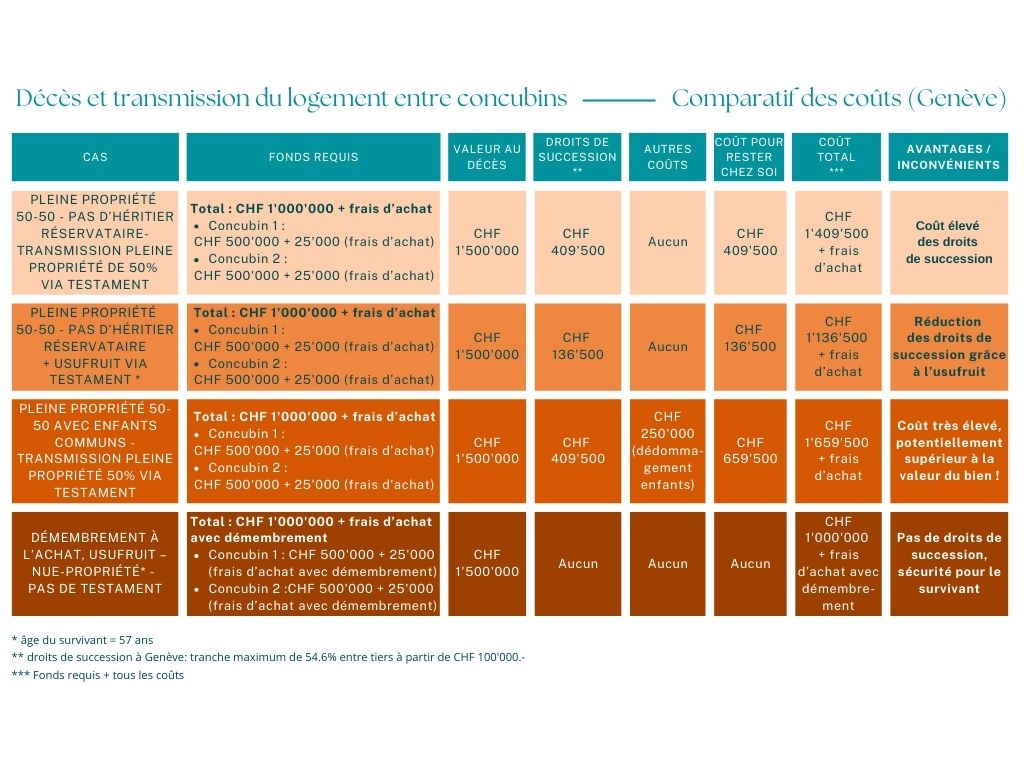
It is clear that the 4th scenario offers the greatest financial advantages:
→ Savings compared to the classic 50-50 full ownership solution: CHF 409,500 + guaranteed retention of the home
→ Savings compared to the classic 50-50 full ownership solution + compensation for children: CHF 659,500 + guaranteed retention of the home
These calculations clearly demonstrate that, without proper planning, a surviving partner risks having to pay a very high sum to continue living in their home. Given the prohibitive cost, which most often occurs in old age when financial income is scarcer, it is imperative to consider implementing one of the options mentioned above.
Advice for married couples
Since inheritance taxes are zero, the focus should be on the right to reside in and dispose of the property, especially if the deceased had children who inherit the home. We detail this below.

“All these questions must be asked at the time of acquisition, with the help of an advisor experienced in these matters,” Maître Frédéric de le Court tells us. The fees invested in structuring the purchase ultimately lead to massive savings.
4. Providing protection in the event of death

A real estate purchase is a long-term commitment. In the event of death or disability, it is essential to provide solutions to protect the surviving spouse/partner and, in particular, allow them to:
- stay in their home
- have enough to live on
To avoid financial or inheritance difficulties, the following elements can be planned:
- Life insurance: it allows for the full or partial repayment of the loan.
- Usufruct or right of residence: differences explained above
- Drafting a will: to allocate one’s share to the surviving spouse. But beware of the statutory shares of children—whether shared or not—which may force the surviving spouse/partner to compensate the forced heirs beyond their current financial means. The desired goal would then not be achieved.
5. Can the situation be regularized after the purchase?

Maître Frédéric de le Court emphasizes the importance of anticipating these questions before the purchase:
“Changing after the acquisition is too late: there are tax frictions (transfer duties, real estate gains, gift taxes, etc.) that make correction prohibitive and therefore illusory. Legal heirs could also object in the event of a gift that would infringe upon their legal reserve.”
It is therefore strongly recommended to anticipate these questions, but if this has not been done, seeking advice can still be useful. Mr. Kevin Rossier also encourages considering the creation of life insurance. And drafting a will, with the help of a lawyer and a notary, is a must.
Conclusion
As we have seen: buying real estate as a couple in Geneva requires careful anticipation of the legal and financial implications. Rigorous structuring, accompanied by advice from a financing expert and a specialized lawyer or notary, helps avoid heavy consequences in the event of separation or death. And it is better to do so before signing the purchase of your home.
Need personalized support?
We are at your disposal to advise you and secure your investment.
About our experts

Mr. Kevin Rossier: Hypo Advisors SA, active in French-speaking Switzerland, is a company specializing in mortgage and pension advice, offering personalized solutions for real estate financing. Kevin Rossier, a former Credit Suisse executive, founded it in 2016 after specializing for over 10 years in the field of real estate financing for individuals and professionals and in real estate.
Contact: contact@hypo-advisors.ch | + 41.22.347.24.24 | LinkedIn

Maître Frédéric de le Court is a tax lawyer in Signy (Vaud). With over 15 years of experience in taxation, he is also a speaker and author of various publications, particularly in the field of real estate taxation.
Contact: fc@dlctax.ch | +41.22.552.79.00 | LinkedIn